Wildfire Mitigation Programmatic Review & Implementation Plan
A comprehensive watershed-scale review and strategic roadmap to reduce post-fire risk, protect critical infrastructure, and prioritize mitigation investments across vulnerable terrain.
Turning fragmented risk data into a fundable action plan
Smart Fusion conducted an end-to-end programmatic review combining GIS mapping, watershed risk analysis, and strategic planning to deliver a prioritized, multi-year implementation roadmap.
Complex, interacting wildfire risks
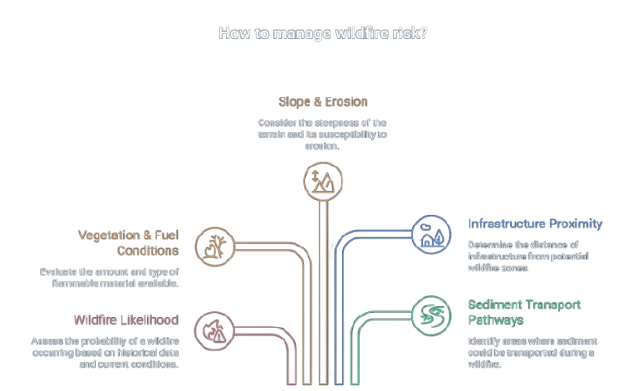
- Vegetation density and fuel conditions creating elevated ignition and spread potential.
- Steep slopes and high erosion potential amplifying post-fire debris and sediment risk.
- Critical infrastructure located in close proximity to high-hazard zones.
- Sediment transport pathways threatening downstream water quality and storage.
- Fragmented data and competing priorities making investment decisions difficult.
A horizontal 4-step consulting framework
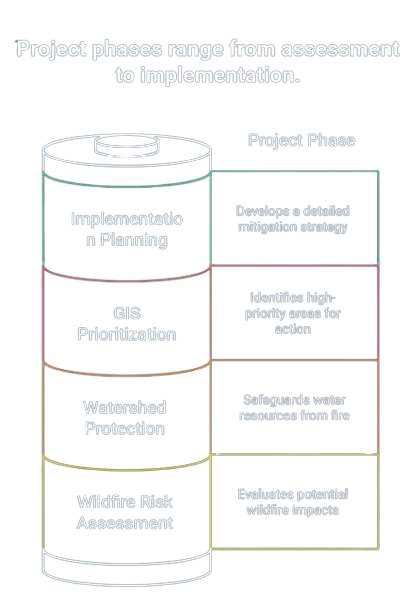
Implementation Planning
Establish goals, scope, and stakeholder alignment.
GIS & Risk Mapping
Develop mitigation maps from spatial data.
Prioritization
Identify priority areas and actions.
Resource Safeguarding
Protect established watershed resources.
What we produced
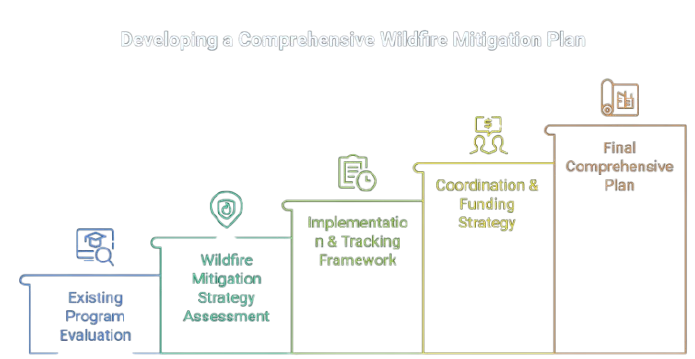
Programmatic Review
Assessment of existing environmental programs, policies, and mitigation activities.
GIS Risk Mapping
Spatial models of fuel, slope, erosion, and infrastructure exposure.
Implementation Roadmap
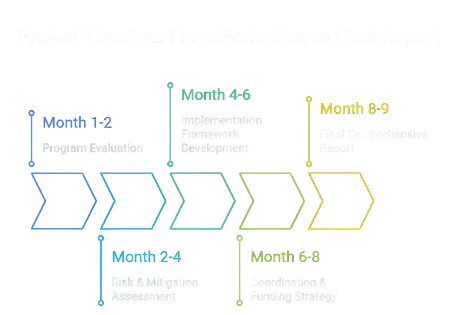
Phased, milestone-driven plan spanning 6–9 months.
Funding Strategy
Assessment of grant and funding opportunities to support execution.
Stakeholder Coordination Plan
Roles, responsibilities, and engagement cadence across partners.
Monitoring Framework
Performance metrics to track mitigation effectiveness over time.
A five-factor Wildfire Risk Score
A central risk score synthesizes the five drivers that most influence wildfire and post-fire watershed risk, enabling objective prioritization.
Phased execution model
Work is organized into clear phases that move from planning and mapping through prioritization to resource safeguarding.
Outcomes
6–9 month roadmap with milestones